Ancient Roman Marble Bust of a Young Girl in the guise of Artemis
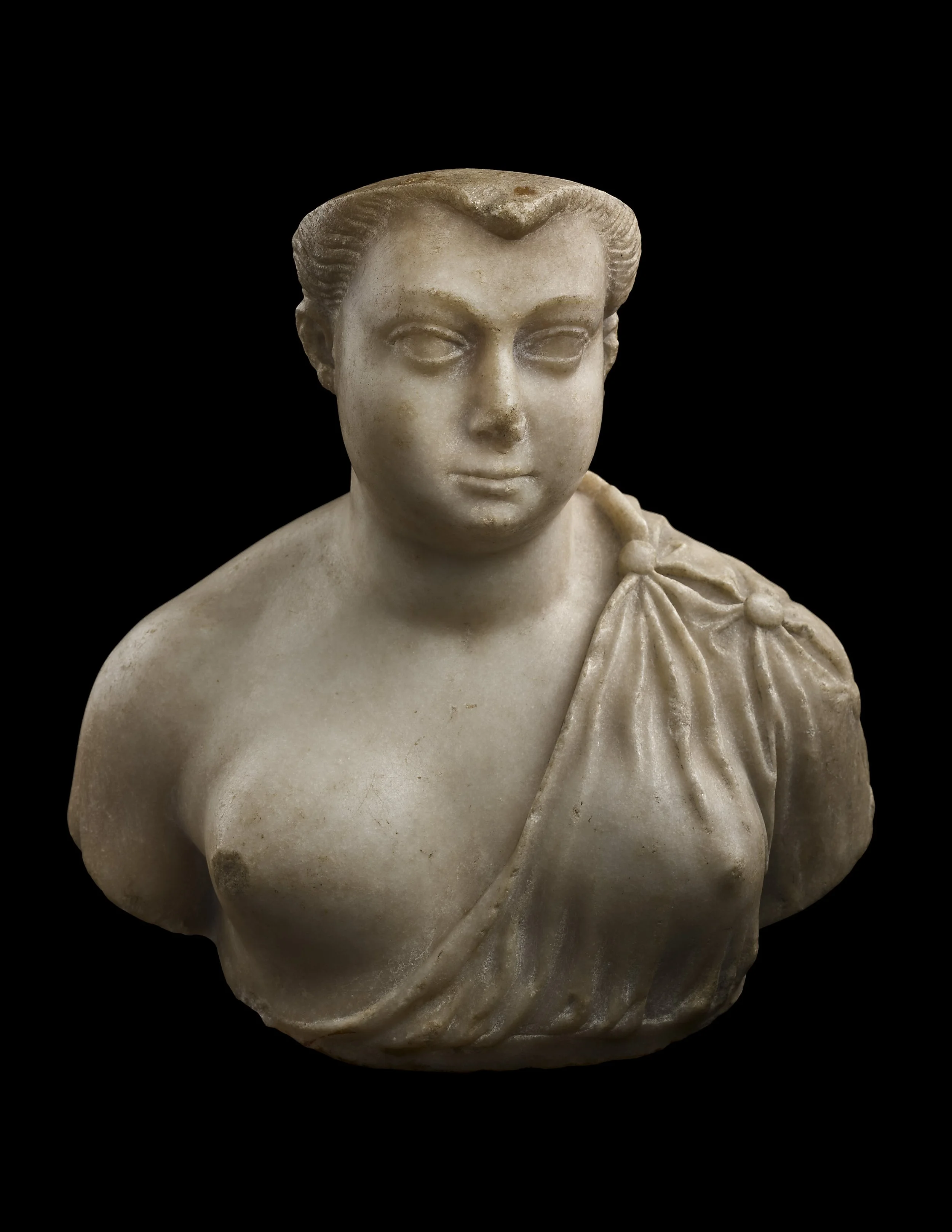
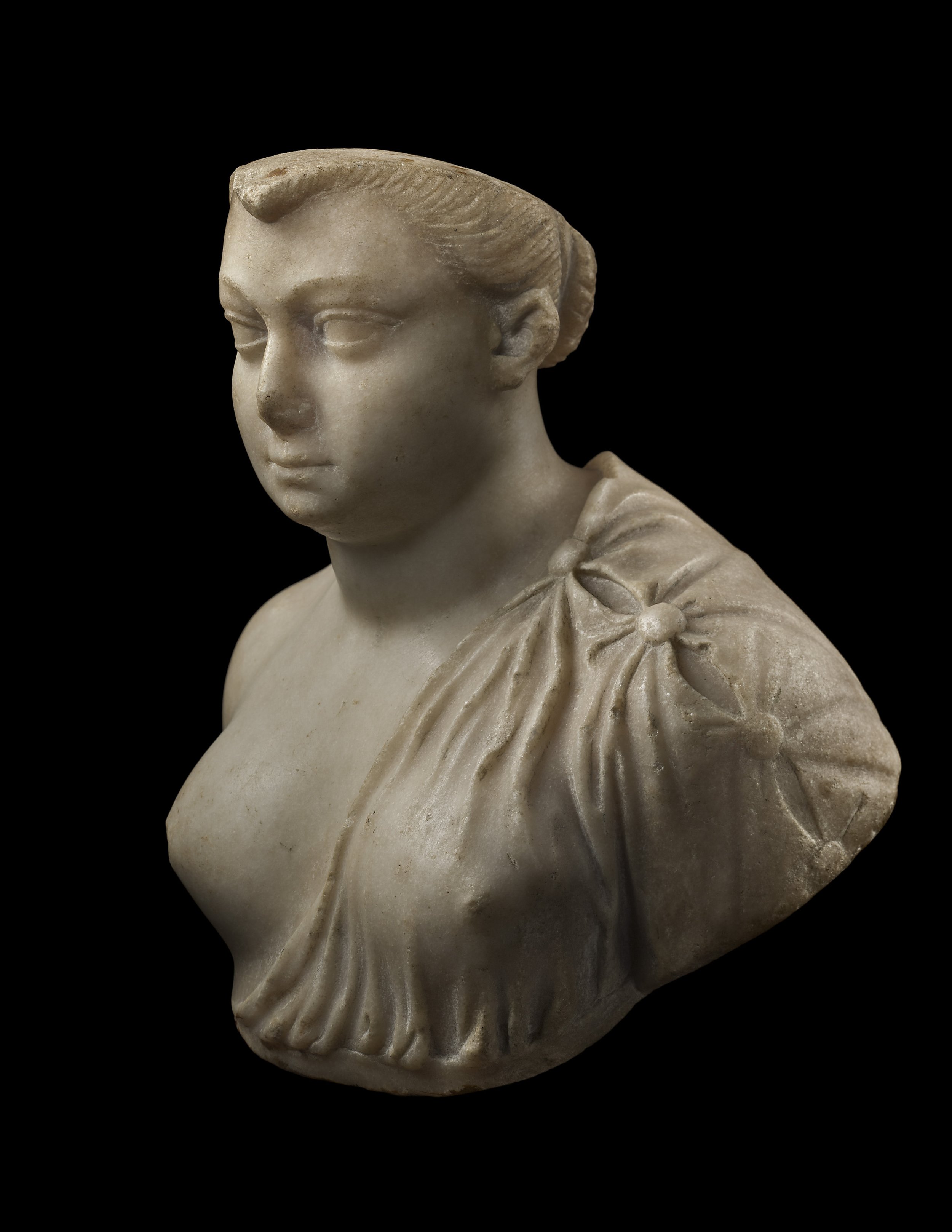
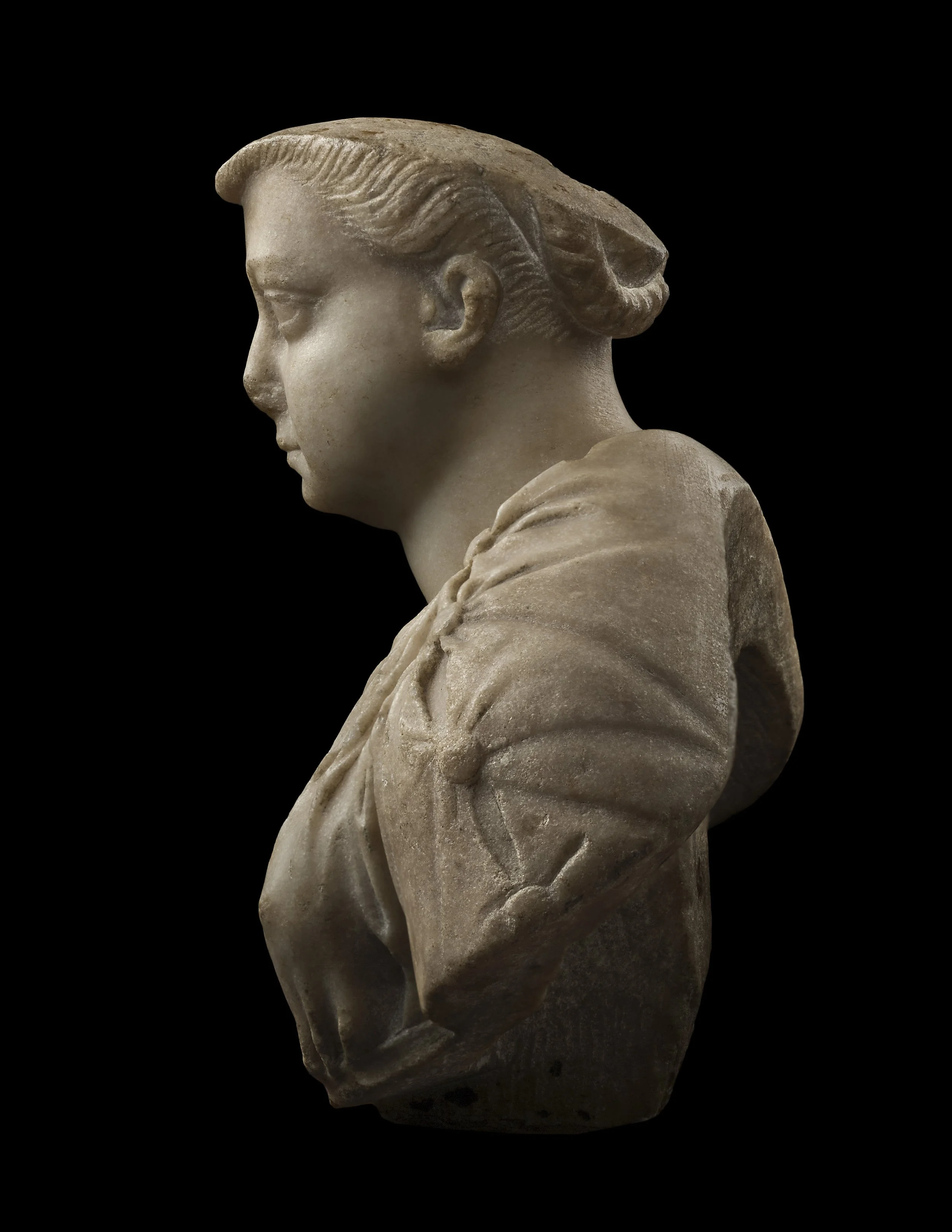
Ancient Roman Marble Bust of a Young Girl in the guise of Artemis
Roman, late 1st century B.C. - early 1st century A.D.
Marble
H: 21.0 cm (8.26 in)
Serial: 31872
The under life-size bust represents a deified young girl; her look, the way she is dressed, link her to a goddess. The surviving part of the hairstyle is sufficient to reconstruct the entire hair design and to date the portrait. The face of the young girl is marked by noticeable individual features: the large, almond-shaped eyes, straight and narrow nose, and thin lips. Compared to a small and delicate chin, the shape of the face is dominated by the full and firm cheeks, which certainly indicate a still very young age of the person.
The young girl is wearing one piece of dress, a chiton. The only sleeve is buttoned over her left shoulder and forearm, while the right shoulder and the breast are left completely bare. This arrangement leaves no doubt that the person was represented in the guise of the goddess Artemis/Diana. Similar iconography is also typical for the images of Amazons, Virtus, and Roma, but the long sleeves are only found in the Classical representations of Artemis. Usually this would be a combination of a chiton with peplos; in the portrait the design of the unique long sleeve and one bare breast is a Roman invention. In addition, the shape of the bust shows that the chiton was belted high under the breasts indicating the Hellenistic fashion of wearing such a dress.
In Roman art, Greek sculptural images were particularly influential in transmitting the Classical gods’ iconography which was adapted for the portrait statues and busts of the mortals. The tradition was reserved for the members of the Imperial family, high social rank individuals, as well as the wealthy. Especially famous was the statue of Artemis the huntress known in several replicas and called as the Versailles Diana in the art-historical tradition.
A Roman representation of a young girl in the entire composition similar to the Versailles Diana is found in the figure of Aelia Procula on her funerary relief (the Louvre, inv. no. MA 1633). She wears the high belted peplos; the strap attached to the quiver at the back crosses her bare chest; she holds the bow, and the hunting dog accompanies her. Both the image (the body proportions and especially firm and very full cheeks) and the dedicatory inscription show her as a girl. In Roman funerary imaginary, the link with Artemis/Diana, the virgin huntress of youthful appearance, indicates that the female person has died as a teenager, at the length of life before the marriage.
The complete hairstyle in the present portrait has quite a remarkable structure which was characteristic for the Roman ladies hairstyle of the end of the Republican - early Augustan era and still remaining during the Toberian period. The hair is very long, at the median line of the head the part of it is assembled into a braid which root creates a prominent bun above the forehead (the so-called nodus-type; it has been also noted that the axial braid appear in the hairstyle of Greek boys and girls, and also Erotes, in the representations of the Hellenistic period). Sometimes the bun receives a distinct triangular form (a good example of it is a portrait of Octavia Minor, sister of Octavian, the marble bust in the Ny Carlsberg Glyptotek, Copenhagen, and her image on the golden aurei). The rest of the divided hair is pulled up and rolled around the invisible fillet, or even metallic headband. At the lower side of the nape, the ends of hair are laid in braids to encircle another bun.
CONDITION
Missing is the broken upper part of the hairstyle which was once restored and connected to the rest with the help of an iron pin: there is a drilled hole in the middle of the crane, as well as the traces of the wax-resin mastic to fix it; surface weathered and cleaned; damaged are the tip of nose, nipple of the proper right breast and the bust’s edge below it; a chip on the hair triangle above the forehead; the low, circular base of bust is missing.
PROVENANCE
Ex- Stanley Hura private collection, New York, acquired ca. 1980;
Ex- E. Tiliakos private collection, Winchester, MA, ca. 2012.
BIBLIOGRAPHY
BALTY J.-Ch., CAZES D., Sculptures antiques de Chiragan (Martres-Tolosane), I, Les portraits romains, I,1, Époque julio-claudienne, Toulouse, 2005, pp. 182-193.
BIEBER M., Ancient Copies: Contributions to the History of Greek and Roman art, New York, 1977, p. 73, fig. 268.
GIULIANO A. et al., Museo Nazionale Romano, Le sculture I, 9,1, Rome, 1987, pp. 174-175, no. R133.
JOHANSEN F., Catalogue Roman Portraits I, Ny Carlsberg Glyptotek, Copenhague, 1994, pp. 94-95, no. 35 (Livia); pp. 108-109, no. 42 (Octavia Minor).
KERSAUSON K. de, Musée du Louvre, Catalogue des portraits romains: Tome I, Portraits de la République et d’époque Julio-Claudienne, Paris, 1986, pp. 72-73, no. 31.
TRILLMICH W., Das Torlonia-Mädchen. Zu Herkunft und Entstehung des kaiserzeitlichen Frauenporträts, in Abhandlungen der Akademie der Wissenschaften in Gottingen, Philologisch-Historische Klasse, series 3, no. 99, Göttingen, 1976.
ZANKER P., Roman Portraits: Sculptures in Stone and Bronze, The Metropolitan Museum of Art, New York, 2016, pp. 194-195, no. 69.