Ancient Roman Finial with Eagle and Swans
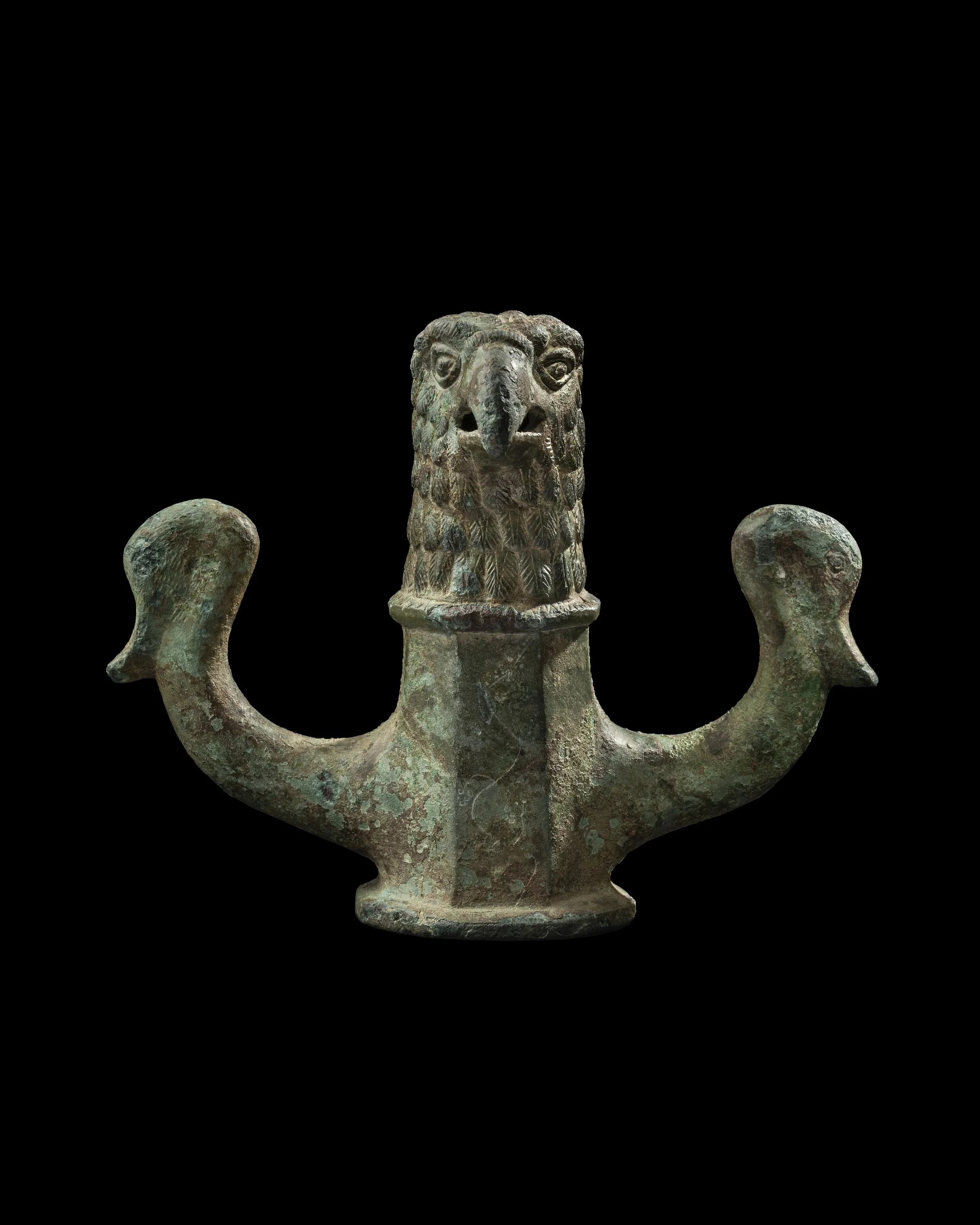
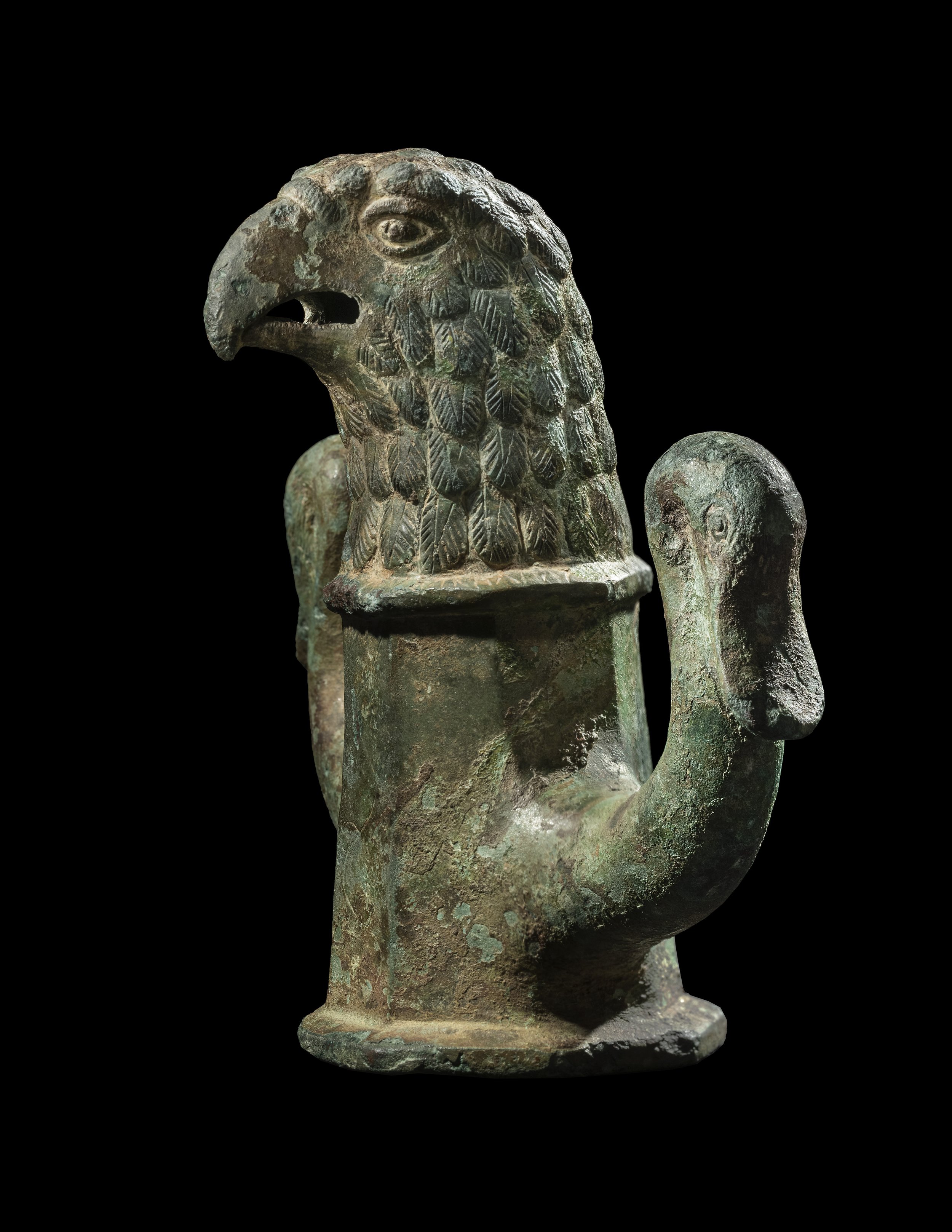
Ancient Roman Finial with Eagle and Swans
Roman, 1st - 2nd century A.D.
Bronze
H: 15.0 cm (5.9 in)
Serial: 4833
This striking cast bronze finial is crowned by a commanding eagle head, flanked symmetrically by two outward- curving arms terminating in smaller swan protomes. It is shaped as an octagonal hollow shaft set on a low base, tapering upward. The central eagle is rendered with pronounced, deeply carved eyes, a sharply hooked beak, and a textured plumage articulated through incised feathering that conveys both naturalism and stylization. The lateral birds, more abstract in form, echo the central motif and create a balanced, almost heraldic composition. The object likely functioned as a decorative terminal, where its imagery would have been both ornamental and symbolic, possibly from a ceremonial staff or chariot where straps of leather reins would be wrapped around the shafts of two such fittings, which were mounted on posts above each wheel of the chariot used in a military parade or ceremonial procession.
The eagle held profound significance in the visual and political language of Ancient Rome. Known as the aquila, it was the principal emblem of the Roman legions and a potent symbol of imperial authority, dominion, and divine favor. Each legion carried an eagle standard, which was both a rallying point in battle and a sacred object imbued with the spirit of the unit. The loss of an eagle was considered a catastrophic dishonor, while its protection was entrusted to the aquilifer, a soldier of elite status.
Beyond its military associations, the eagle was closely linked to Jupiter, the king of the Roman gods. As Jupiter’s sacred bird, the eagle signified power, sovereignty, and the connection between the earthly and divine realms. In imperial iconography, it often appears as a bearer of apotheosis, carrying the soul of a deified emperor to the heavens.
This finial thus embodies more than decorative artistry; it reflects a visual language of authority and protection deeply embedded in Roman culture. The prominence of the eagle motif suggests that the object’s original context, whether civic, military, or domestic, was one in which status, allegiance, or divine sanction was to be clearly communicated.
CONDITION
Oxidation in places; minor dents at eagle’s ‘collar’; a sinuous scratch at the front facet of the shaft; an original round hole at back for the attaching.
PROVENANCE
Ex- Swiss private collection, acquired in the 1970-1980's; Private collection since 1998.
BIBLIOGRAPHY
BORGER H., Das Römisch-Germanisch Museum Köln, Munich, 1977, p. 133, no. 124.
BOUBE-PICCOT C., Les bronzes antiques du Maroc III, Les chars et l'attelage, Rabat, Musée des Antiquités, 1980.